Techniques
- Casting
- Styles
- Tips
- Targeting
- Drifts
- Rigging
- General Rigging
- Knots
- Tippet Sizing
- Dry Hopper Rigging
- Fly Selection
- Resources
Casting
Follow these general tips when casting:
- Don't break wrist
- Keep the rod tip should go in a straight motion, it shouldn't angle down towards the water
- Always keep line under right hand when stripping
Overhead Cast
- Description: Most common technique; useful in open areas
- Technique:
- Lift the rod smoothly, pause, and cast forward with controlled force
- Can pick up and lay down the line, false cast, and shoot line out
- Keys:
- Use the right amount of line in the water; don't hold any stripped line in your left hand
- Keep the line straight in the water
- Start with a low rod tip
- Pause on the backcast, don't break the wrist, and avoid casting too far forward
- The tighter the arc of your hand, the tighter the loop will be
- Keep the rod tall and straight for false casting, but don't false cast too much
- To shoot line out: strip line first and release your finger when casting
- Start with right foot forward
- Resources:
- Intro to Overhead Cast Article
- Basic Fly Cast or Overhead Cast Video
- How to Perfect Your Forward Cast
- ORVIS - Fly Casting Lessons - The Basic Fly Cast Video
- ORVIS - Fly Casting Lessons - How To Hold Your Line Hand
Roll Cast
- Description: Effective in tight spaces with obstacles behind
- Technique: Flick the rod tip forward from a looped line position on the water
- Keys:
- Start with some line in water and a bit behind shoulder
- Hand position should be next to ear/shoulder with the rod tip turned outward
- Bring hand forward and push with thumb to cast
- Stop rod tip at eye level
- Avoid dropping tip
- Resources:
- Roll Cast Video Tutorial
- Overhead and Roll Casting Instructions
Single Haul Cast
- Description: Adds extra line speed and distance to a cast
- Technique: Pull on the line with the non-rod hand during either the backcast or forward cast, but not both
- Keys:
- Resources:
- Single Haul Video Tutorial
Sidearm Cast
- Description: Provides accuracy in windy conditions or under cover
- Technique: Cast parallel to the water to avoid low-hanging branches
- Keys:
- Resources:
Double Haul Cast
- Description: Increases line speed for longer casts
- Technique: Pull on the line with the non-rod hand during both the backcast and forward cast.
- Keys:
- Resources:
Reach Cast
- Description: Allows for better line positioning on the water
- Technique: Extend the rod arm in the desired direction mid-cast
- Keys:
- Resources:
Spey Cast
- Description: Ideal for large rivers and strong currents
- Technique: Uses a longer rod and sweeping motion for line control without a backcast
- Keys:
- Resources:
Tuck Cast
- Description: Drops the fly quickly for deeper nymphing
- Technique: Perform a sharp downward flick at the end of the cast
- Keys:
- Resources:
Bow and Arrow Cast
- Description: Used in extremely tight spots where a backcast isn’t possible
- Technique: Pull the fly back like an arrow and release forward
- Keys:
- Resources:
Water Haul
- Description:
- Technique:
- Keys:
- Resources:
Mend Cast
- Description:
- Technique:
- Keys:
- Resources:
Styles
Nymph Fishing
Euro Nymphing
Wet Fly Fishing
Streamer Fishing
Tenkara
High Sticking
Bass Fishing
Bass Fishing Rigs
Spin Fishing
Tips
Targeting
- Target different areas of rivers by working the entire body of water
Drifts
Rigging
General Rigging
- Dry fly: leader -> 5X -> dry fly (5X can be tied onto existing 3X)
- Hopper: leader -> 5X -> dry fly -> 3X -> wet fly (5X can be tied onto existing 3X)
- Single nymph: leader -> 3X -> nymph (with indicator)
- Double nymph: leader -> 3X -> nymph -> 3X -> nymph (with indicator)
- Streamer: leader -> 3X -> streamer
Knots
- Full clinch for flies/lures
- Surgeons for leader to leader or droppers
- Perfection loop for Tenkara
- Use spit on knots to ensure they seat properly
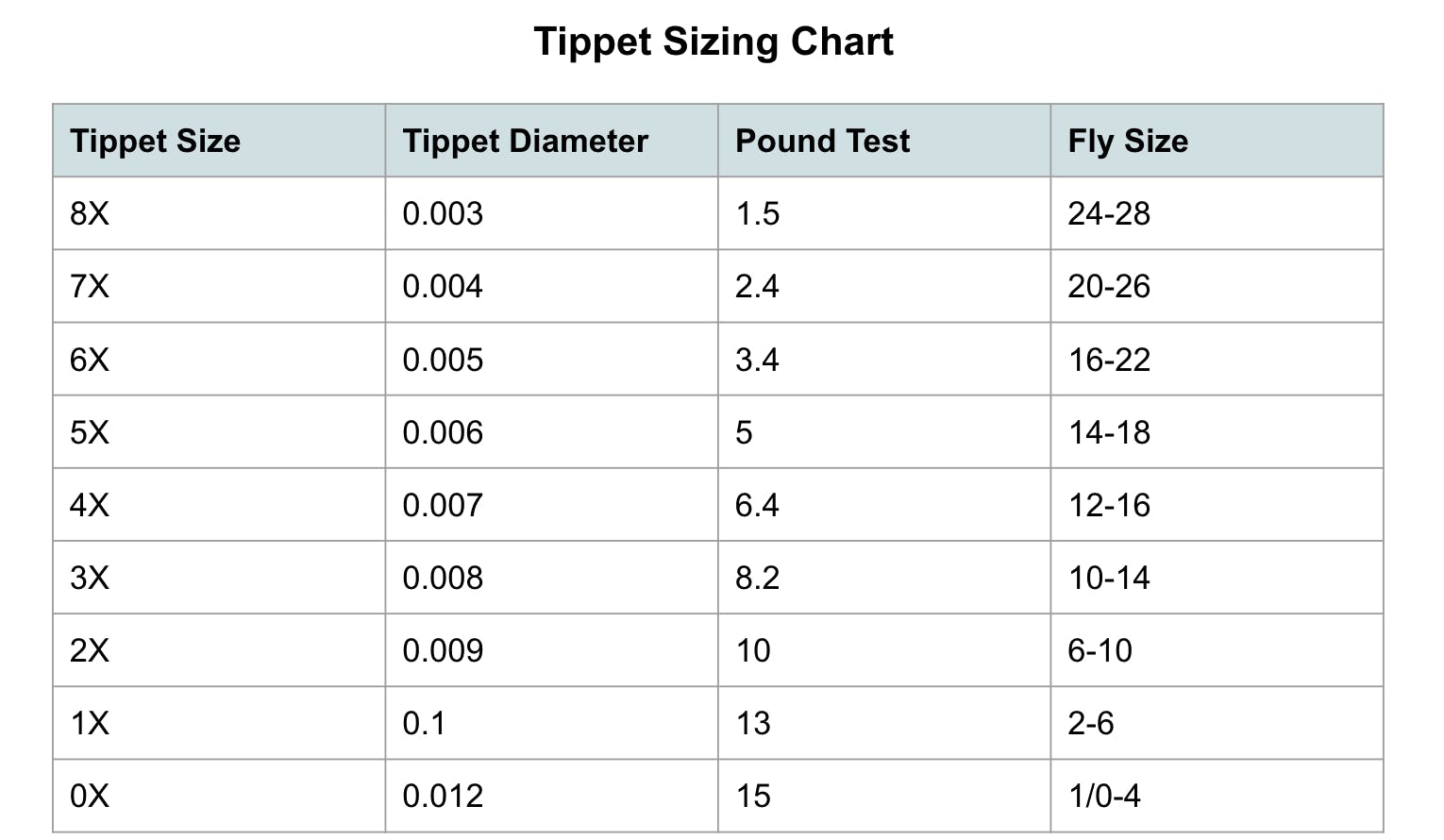
Tippet Sizing
Dry Dropper Rigging
- General Dry Hopper Setup
- https://www.hatchmag.com/articles/dry-dropper-nymphing-approach-low-water/7715593
Fly Selection
Use nylon pants to keep off the bugs & sun, worn with a pair of thin socks, wading socks, and rubber-soled wading boots.
- Pick up rocks to see what's underneath for fly selection
- Ducks typically mean hoppers
- Any trout in the world will eat a size 18 Pheasant Tail out of a river
Wet Flies:
Use small black baetis, or other wet fly, with split shot relative to depth, and no indicator. Use 2 1/2 feet of 5X tippet tied on the end of the tenkara line - using a tippet ring - to the fly. The split shot is about a foot above the fly.